Story
When Amazon's Numbers Disappear: Why Indie Authors Need a Publishing Plan Beyond KDP
Some links in this post are affiliate links. If you buy through them I may earn a small commission, at no extra cost to you. I only share things I truly use and love.
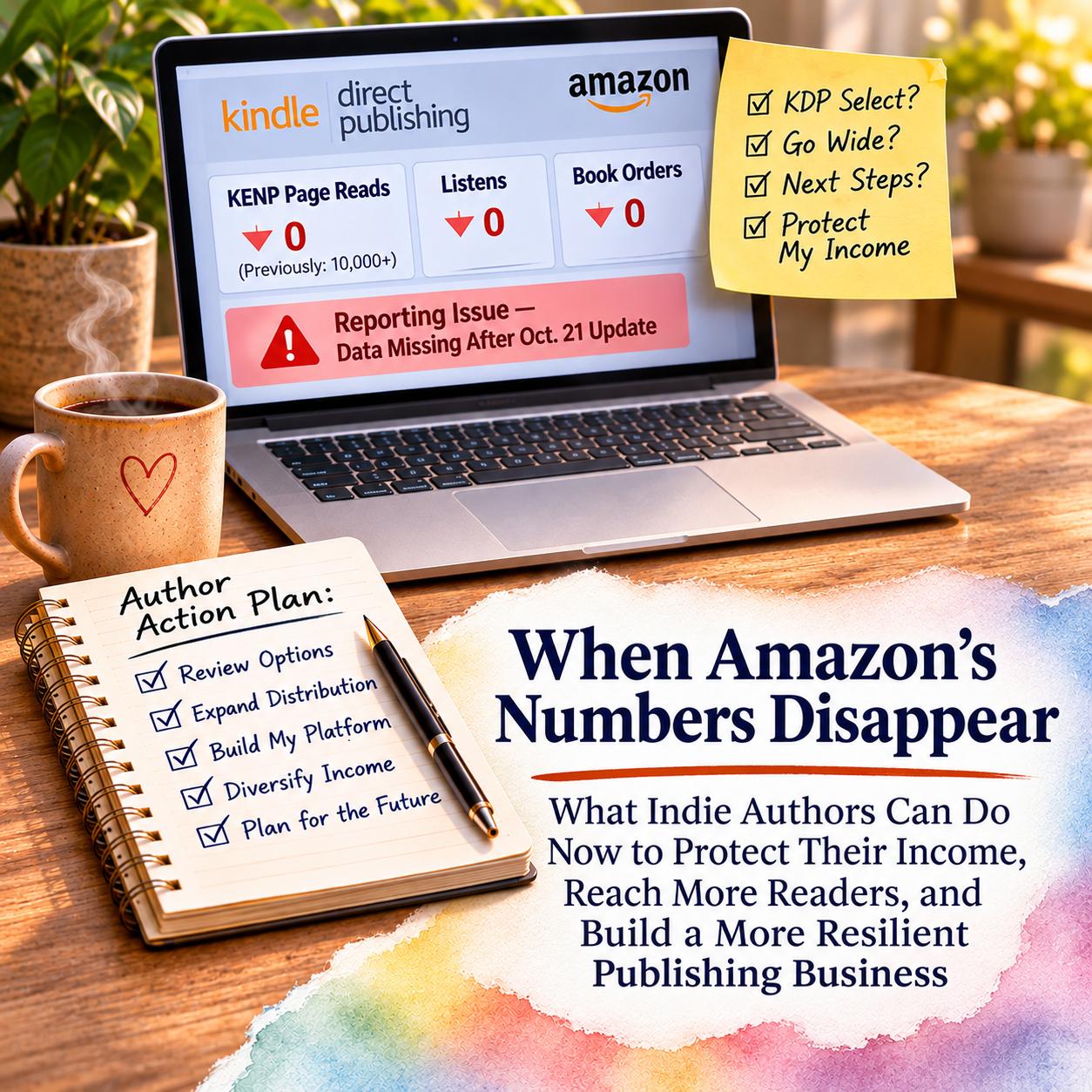
The October 21st KDP reporting disruption raises some uncomfortable questions about author income, platform accountability, and the future of independent publishing.
For independent authors, there's something particularly satisfying about opening your publishing dashboard and seeing those numbers climb.
Book sales. Kindle page reads. Audiobook listens. Royalties.
Each number represents something meaningful: a reader discovering your work, someone spending time with a story you've created, or perhaps a new customer purchasing a book you spent months writing.
And, of course, those numbers represent income.
Now imagine opening that same dashboard one morning and discovering that a substantial portion of those numbers has simply vanished.
Not because your books were suddenly unpopular. Not because you stopped marketing. Not because your readers lost interest overnight.
But because something changed behind the scenes at the platform responsible for tracking and reporting your earnings.
Welcome to my experience with Amazon Kindle Direct Publishing (KDP) since October 21, 2026.
The Day My KDP Numbers Flat-Lined
I've been independently publishing books for years. My catalog spans fiction, nonfiction, health and wellness, and other creative projects.
Like many indie authors, I've invested considerable time and effort into learning Amazon's publishing ecosystem, optimizing my book listings, experimenting with advertising, and building an audience.
And through September 2026, things were moving in an encouraging direction.
My Kindle Edition Normalized Pages (KENP) reads had climbed into the tens of thousands per month. September was particularly promising, and October appeared to be following a similar trajectory.
Then came October 21st.
Amazon introduced significant changes to its Kindle subscription ecosystem, including the transition from Kindle Unlimited to Kindle+ and changes to how reading and listening activity appeared in author reports.
Suddenly, previously reported activity disappeared from my dashboard.
Page reads. Listening activity. Even physical book orders were affected in my account.
These weren't simply disappointing new sales figures. I was looking at discrepancies involving activity that had previously been reported.
Naturally, I contacted Amazon KDP support.
Not once. Not twice. But three separate times.
During live text chat conversations, three different customer service representatives acknowledged what they described as a technical problem, assured me that Amazon's technical team was aware of it, and that my missing numbers would be restored.
Nearly a month later, I'm still waiting.
My account has not returned to its previous reporting levels, and I have not received a satisfactory resolution explaining what happened to the activity that disappeared.
And this is where the issue becomes much bigger than a frustrating software update.
I'm Not the Only Author Asking Questions
I'm a member of a large Facebook community of independent authors, and I've seen numerous other writers describing similar experiences.
Some reported dramatic reductions in previously displayed KENP reads. Others questioned changes to estimated royalties or historical reporting. Still others described confusion over the separation of audiobook listening activity from ebook page reads.
Public discussions elsewhere have echoed these concerns.
On October 21, one author on Reddit reported seeing approximately 100,000 monthly page reads fall to around 75,000 overnight. Another author subsequently described a drop from more than 26,000 pages to roughly 11,000, along with a substantial change in estimated royalties.
These are individual reports, not independently audited evidence of unpaid royalties. But the similarities are difficult to ignore.
Amazon has explained that changes to Kindle+ reporting affect how certain reading and audiobook listening activity is displayed, particularly for titles participating in its Virtual Voice audiobook program.
That explanation may account for some discrepancies.
But it doesn't automatically answer every author's questions about historical figures, individual accounts, or the relationship between previously displayed activity and eventual compensation.
And it certainly doesn't eliminate the need for clear, consistent communication.
When authors cannot independently verify the activity that determines their compensation, transparency becomes essential.
This Isn't Just About Numbers. It's About Income.
Let's be clear about something.
Independent publishing is a business.
Yes, many of us write because we love storytelling, sharing knowledge, or leaving a legacy.
But loving your work doesn't make your time worthless.
Authors invest in editing, cover design, formatting, software, advertising, websites, professional services, and countless hours of labor.
We take financial risks to bring our books into the world.
And when readers purchase or consume those books through a platform that promises compensation, we have a reasonable expectation that the resulting activity will be accurately tracked and reported.
To be fair, estimated royalties are not necessarily final royalties. Amazon's own documentation explains that monthly KENP reporting can change before figures are finalized.
But there's a meaningful difference between routine reporting adjustments and significant, unexplained changes that leave authors unable to reconcile their records.
A software problem can happen to any company.
The real measure of accountability is how a company communicates, investigates, corrects errors, and addresses any resulting financial discrepancies.
For authors depending on that income to pay bills, fund their next publication, or simply justify continued investment in their businesses, this is no small matter.
The Bigger Problem: We Don't Control the Platform
This experience has forced me to reconsider something I've known intellectually for years but perhaps hadn't fully appreciated in practice.
When we publish exclusively through Amazon's KDP Select program, we surrender a significant amount of control over how our ebooks reach readers.
In exchange, we receive access to Amazon's subscription readership and certain promotional opportunities.
For some authors, particularly those writing in genres with strong subscription demand, that trade-off can be extremely profitable.
But what happens when the expected benefits stop materializing?
What happens when visibility declines, advertising becomes increasingly expensive, or reporting becomes unreliable?
What happens when an author is contractually committed to exclusivity but no longer sees meaningful returns from that commitment?
That's when the risks of depending too heavily on a single platform become painfully obvious.
And it's why I've been reconsidering my own publishing strategy.
What Can Authors Do When They're Locked Into KDP Select?
First, an important distinction: publishing through Amazon KDP and enrolling in KDP Select are not the same thing.
You can sell ebooks and paperbacks on Amazon without enrolling your ebooks in KDP Select.
KDP Select is an optional program with 90-day enrollment periods and specific exclusivity requirements.
If you're enrolled and no longer receiving enough benefit to justify that exclusivity, you do have options.
1. Turn off automatic renewal.
Visit your KDP Bookshelf, locate the title, and open its KDP Select enrollment management settings.
Review the current enrollment period and disable automatic renewal.
This prevents another 90-day commitment from beginning automatically.
2. Understand your current contractual obligations.
Turning off renewal generally does not end the existing enrollment period.
Amazon normally permits cancellation during the first three days of a new enrollment period. After that, authors seeking an early release must contact KDP support.
Don't assume that unpublishing a title immediately releases it from exclusivity. Amazon's rules explain that unpublishing can pause the enrollment period rather than terminate the obligation.
3. Request an early release when appropriate.
If you're experiencing documented technical problems, missing reporting, or other unresolved concerns, contact KDP support and ask whether an early release is possible.
Explain your circumstances clearly, provide supporting evidence, and request written confirmation of any decision.
Approval is not guaranteed, but asking is reasonable.
4. Prepare your wide-distribution strategy while you wait.
You can use the remaining enrollment period productively.
Prepare EPUB files, review covers and metadata, research retailers, update your author website, and develop a launch plan.
Just don't distribute the exclusive ebook through competing channels until the applicable exclusivity period has ended or Amazon has explicitly released you.
And remember: KDP Select's ebook exclusivity does not generally prevent you from distributing your print editions through other channels.
Going Wide: Building a Publishing Business With More Than One Door
In independent publishing, going wide simply means making your books available through multiple retailers and distribution channels rather than restricting them to Amazon's subscription ecosystem.
And there are some compelling reasons to consider it.
A few distribution options worth exploring:
- Draft2Digital: A distribution service that can help authors reach multiple ebook retailers and library platforms from a single dashboard.
- Apple Books: An opportunity to reach readers within Apple's international ecosystem.
- Kobo Writing Life: Direct ebook publishing with access to Kobo's retail audience and eligible subscription opportunities.
- Barnes & Noble Press: Direct publishing for readers who prefer the Barnes & Noble ecosystem.
- Google Play Books: Another digital storefront with international reach.
- Library distribution: Services such as OverDrive, Hoopla, and cloudLibrary can introduce your work to library patrons, subject to each platform's availability and acceptance requirements.
- Direct sales: Your own author website can provide another way for readers to purchase your books.
You don't necessarily have to manage every retailer individually.
An aggregator such as Draft2Digital can simplify distribution, although it generally retains a portion of sales revenue in exchange for that service.
For authors who prefer greater direct control, publishing individually to selected retailers may make more sense.
The important thing is to understand your options rather than assuming Amazon is the only viable marketplace.
But will going wide actually increase sales?
Possibly. But not automatically.
This is an important distinction.
Simply uploading your books to six additional retailers doesn't guarantee that readers will discover them.
Wide distribution creates opportunities for additional visibility, but those opportunities still require thoughtful positioning, effective metadata, appropriate pricing, and marketing.
Authors also need to consider what they may lose by leaving KDP Select, including subscription-related royalties and exclusive promotional tools.
For some books, remaining in Select may still be the most profitable decision.
For others, particularly those receiving little meaningful subscription activity, exclusivity may represent an unnecessary limitation.
The goal isn't to abandon Amazon out of frustration. It's to make informed business decisions based on actual performance and long-term opportunity.
Seven Ways to Protect Your Author Business Going Forward
Regardless of whether you publish exclusively or distribute widely, I believe there are practical steps every indie author should consider.
1. Keep independent records of your publishing activity.
Download royalty reports regularly. Save screenshots of unusual changes. Maintain a simple spreadsheet tracking sales, reads, listens, advertising expenses, and payments.
Your own records won't replace a retailer's official accounting, but they can provide essential evidence when discrepancies occur.
2. Build an author website you control.
Your website should be the central destination for your author identity, catalog, reader resources, and purchasing options.
Retailers can change policies. Social media platforms can change algorithms.
Your own domain gives you a more stable home for your business.
3. Develop direct relationships with readers.
An email newsletter, blog, or reader community can help you maintain relationships beyond any single retailer.
You don't need to overwhelm subscribers with constant promotions.
Useful content, personal insights, new releases, and occasional special offers can help build long-term trust.
4. Diversify where your books are sold.
Consider a combination of Amazon, other ebook retailers, library platforms, print distribution, and direct sales.
Diversification won't eliminate business risk, but it can reduce your dependence on one company's reporting systems, policies, or algorithms.
5. Stop confusing visibility with profitability.
Advertising impressions, clicks, bestseller rankings, and page reads can all provide useful information.
But the numbers that ultimately matter are sustainable revenue and profit.
If you're spending more to attract readers than you're earning from their purchases or reading activity, something needs to change.
6. Think beyond a single book or income stream.
Depending on your expertise and audience, your intellectual property may support additional formats, editions, bundles, audiobooks, educational resources, or related products.
Not every author needs to diversify into multiple businesses. But having more than one viable revenue stream can provide a valuable financial cushion.
7. Evaluate your publishing strategy regularly.
What worked two years ago may not be working today.
Review your actual earnings by title, format, and sales channel. Compare those results with your expenses and the time required to maintain each channel.
And don't be afraid to change direction when the evidence suggests you should.
My Own Decision: It's Time to Reconsider Exclusivity
I've spent years building my publishing catalog, learning the platforms, and working to improve my books' visibility.
I've experimented with Amazon advertising. I've optimized listings. I've invested in tools, education, and marketing.
And I've experienced the excitement of watching readership grow.
But the events following October 21 have reinforced an uncomfortable realization:
I cannot build a financially resilient publishing business around a system I have no ability to independently verify or control.
That doesn't mean I'm removing my books from Amazon.
Amazon remains an enormous marketplace, and I have every intention of continuing to make my books available to its customers.
But I am moving away from the assumption that Amazon exclusivity is necessarily the best strategy for my work.
As my existing enrollment periods expire, I'm evaluating opportunities to expand distribution and make my books available to readers through additional channels.
I'm also placing greater emphasis on my own website, my author identity, and the relationships I build directly with readers.
Because ultimately, I want my publishing business to be built around my books and my audience—not around one company's algorithm or subscription program.
Independent Publishing Should Mean Independence
Perhaps that's the most important lesson in all of this.
We call ourselves independent authors.
We choose what to write. We control our creative vision. We make our own publishing decisions.
But independence becomes somewhat questionable when access to our readers, visibility, and a substantial portion of our income depends entirely on a platform we don't control.
I don't believe the answer is to reject Amazon altogether.
I believe the answer is to stop treating any single retailer as indispensable.
Amazon should be a valuable distribution partner, not the foundation upon which our entire publishing future rests.
And when reporting discrepancies arise, authors deserve clear explanations, accurate accounting, timely resolution, and correction of any confirmed payment errors.
As of this writing, I'm still waiting for a satisfactory resolution to my own KDP reporting concerns.
But I'm no longer waiting to reconsider my business strategy.
Because the most important thing an independent author can own isn't a ranking, a dashboard, or a retailer relationship.
It's the ability to choose what happens next.
Practical Resources for Your Independent Publishing Journey
As indie authors, our greatest defense against platform shifts is building direct reader relationships and diversified marketing habits:
Need immediate visibility for a wide or backlist title?
My Author Book Spotlight ($104) puts your book directly in front of 10,000+ readers across Facebook, LinkedIn, and a permanent spotlight on Self-PublishedAuthor.com.
Want to rethink your complete author marketing system?
Grab my guide, The Subtle Art of Selling Books — 2026 Edition, for a no-hype, choose-your-path framework to selling books in a changing landscape.
Let's Talk About It
Are you an independent author who experienced changes to your KDP page reads, audiobook listens, or royalties following the October 21 update?
Have your numbers been restored? Have you received a satisfactory explanation from Amazon?
And perhaps most importantly, are you reconsidering KDP Select exclusivity in favor of wider distribution?
I'd genuinely love to hear about your experience and what you're doing to protect your author business going forward.
Share your thoughts in the comments. This is a conversation worth having.