
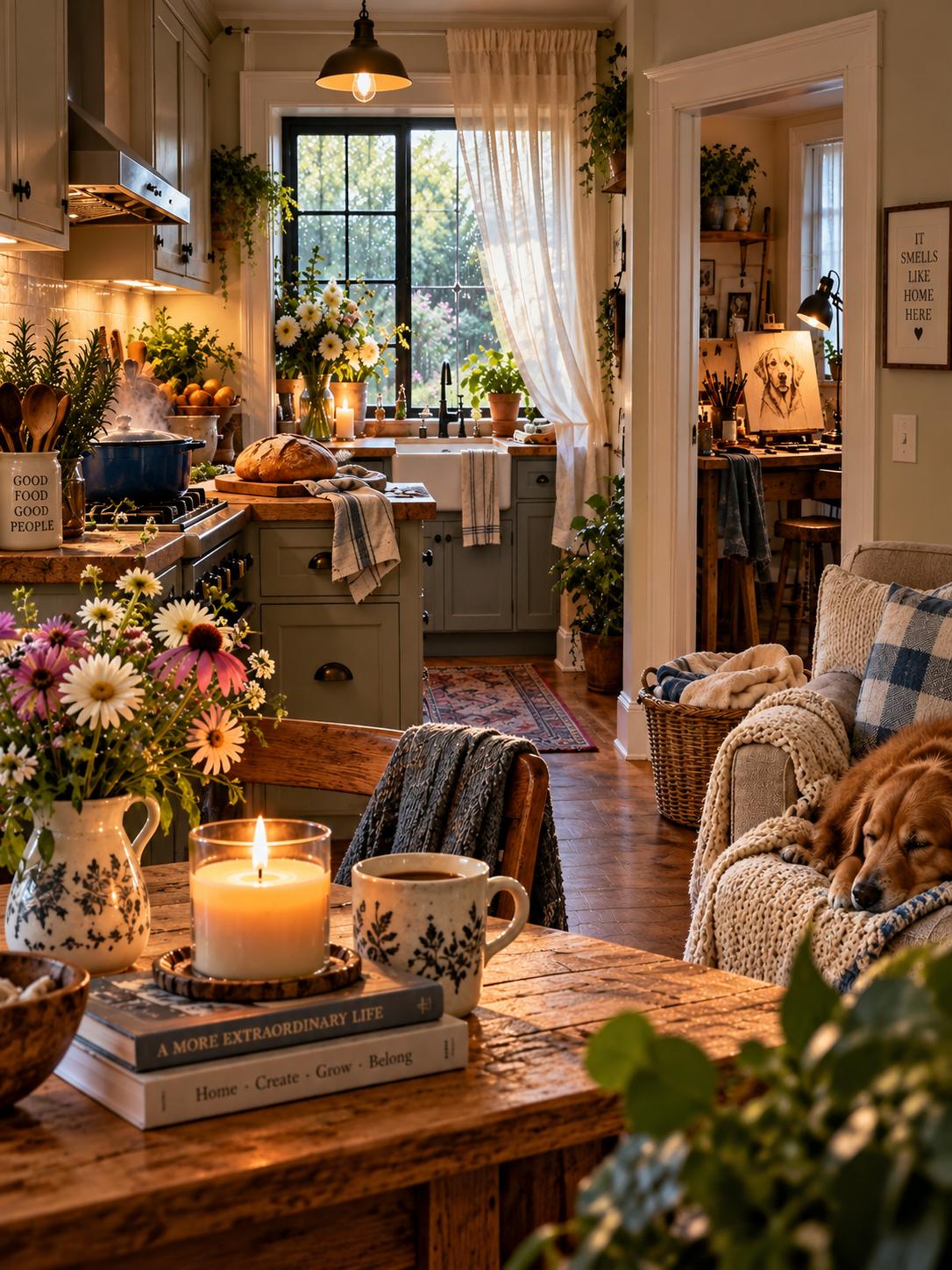
Close your eyes and think about what makes a house feel like home.
Chances are, alongside the things you see, there’s something else at work—something you may not consciously think about at all:
Scent.
Cedar. Beeswax. Fresh laundry. Coffee brewing in the morning. The familiar sweetness of a room that is lived in and loved.
We spend hours choosing paint colors, arranging furniture, and finding just the right decorations to make our environment beautiful. But home fragrance is part of the atmosphere, too—and often some of the most memorable scents aren’t fragrances we’ve purchased at all.
They’re the aromas created by the way we live.
A kettle of beef stew simmering on the stove. Sheets tumbling in the dryer. A jar candle burning near the front door. The clean scent that blows through an open window after a summer rain.
In my case, even the faint smell of burning wood wafting through the house from an afternoon spent creating a portrait in the studio.
Together, they create something no bottled fragrance can quite duplicate:
the scent of home.
Start in the Kitchen
There may not be a candle on the market that can truly rival a loaf of bread fresh from the oven.
The same goes for peaches bubbling beneath a cobbler crust, citrus peel and cloves warming on the stovetop, onions caramelizing in a skillet, or herbs and butter gently browning in a pan.
The kitchen is a natural fragrance laboratory where the aromas change right along with the way we eat and the seasons we live through.
Tuesday might smell like garlic and sage. Saturday morning might smell like pancakes and maple syrup. October might bring apples and cinnamon, while summer smells of basil and tomatoes picked fresh from the garden.
Unlike a plug-in or room spray, the fragrance changes with your life.
Find a Candle That Smells Like Your Home
I love the simple ritual of lighting a candle—not only when company is coming, but just for myself.
Rather than choosing whatever scent happens to be fashionable, I think it’s much more interesting to find fragrances that actually feel at home in your home.
Maybe that’s sandalwood, amber, or tobacco leaf. Maybe it’s fig, bergamot, vanilla, black tea, or something green and herbal.
Maybe your house absolutely should smell like pumpkin spice by September 1st, and no one is going to convince you otherwise. 😉
The point isn’t to create the “correct” home fragrance. It’s to discover the scents that make you walk through your own door and think:
Ahhh. I’m home.
Bring the Garden Inside
Some of the loveliest natural home fragrances come straight from the garden. Roses, lavender, jasmine, honeysuckle, and other fragrant flowers can completely change the character of a room.
Herbs may be even more interesting because they’re both beautiful and useful.
I recently cut sprigs of rosemary from the garden, bundled them loosely with twine, and hung them in my kitchen to dry.
Every time I walk into the kitchen, there it is—that bracing, resinous green fragrance. And as the rosemary dries, the scent changes.
That’s one of the things I love about real botanicals. They’re seasonal and imperfect. They change with time. Eventually, those dried herbs will come down and actually be used.
Beautiful and practical is a combination I will almost always vote for.
Don’t Forget the Scents Created by What You Do
This may be my favorite part.
Some of the most distinctive scents in our homes aren’t intentionally added at all.
Because I practice pyrography—the art of drawing with heat on wood—my creative space sometimes carries that unmistakable campfire-like scent of burning wood.
Someone else’s home might carry traces of oil paints, potter’s clay, freshly cut lumber, or whatever craft, hobby, or project happens there.
Those fragrances aren’t something you can buy. They’re evidence of a life in progress.
And perhaps that’s why they can become such powerful sensory memories.
Years later, the scent of an old leather chair might bring back Grandpa’s study. A particular perfume may suddenly transport someone to their grandmother’s dressing table. The sharp smell of freshly cut grass might conjure childhood summers spent playing outside until dark.
Scent has a remarkable way of attaching itself to the places and moments that matter to us.
Let Your Home Develop Its Own Fragrance
The goal isn’t to make every room smell intensely of the same thing.
In fact, I think the most interesting homes are just the opposite.
Let the kitchen smell like whatever is cooking. Open the windows when the weather is beautiful. Bring something fragrant in from the garden. Let the clean smell of freshly washed linens drift down the hallway. Light something you love in the evening.
Let the scents of the things you actually do become part of the mix.
A home doesn’t need a manufactured signature fragrance. Given enough time and life, it develops one of its own.
And maybe that’s what we’re really creating when we pay attention to these little things—not simply a house that smells nice, but another sensory layer of home.
This place is cared for. This place is alive. This place is ours.
What Does Your Home Smell Like?
What scents have become part of the personality of your home?
Maybe it’s a certain kind of soap beside the kitchen sink, an old cedar chest, shampoo lingering in the bathroom after a shower, or the unmistakable smell of roasting chicken for Sunday dinner.
Or maybe it’s something completely unexpected—a craft, a favorite perfume, rain hitting warm pavement, or even a beloved dog coming back inside after an adventure.