There are some art projects that begin with a clear idea of what you want to create—and then teach you something entirely different along the way.
My Mona Lisa pyrography portrait became one of those projects.
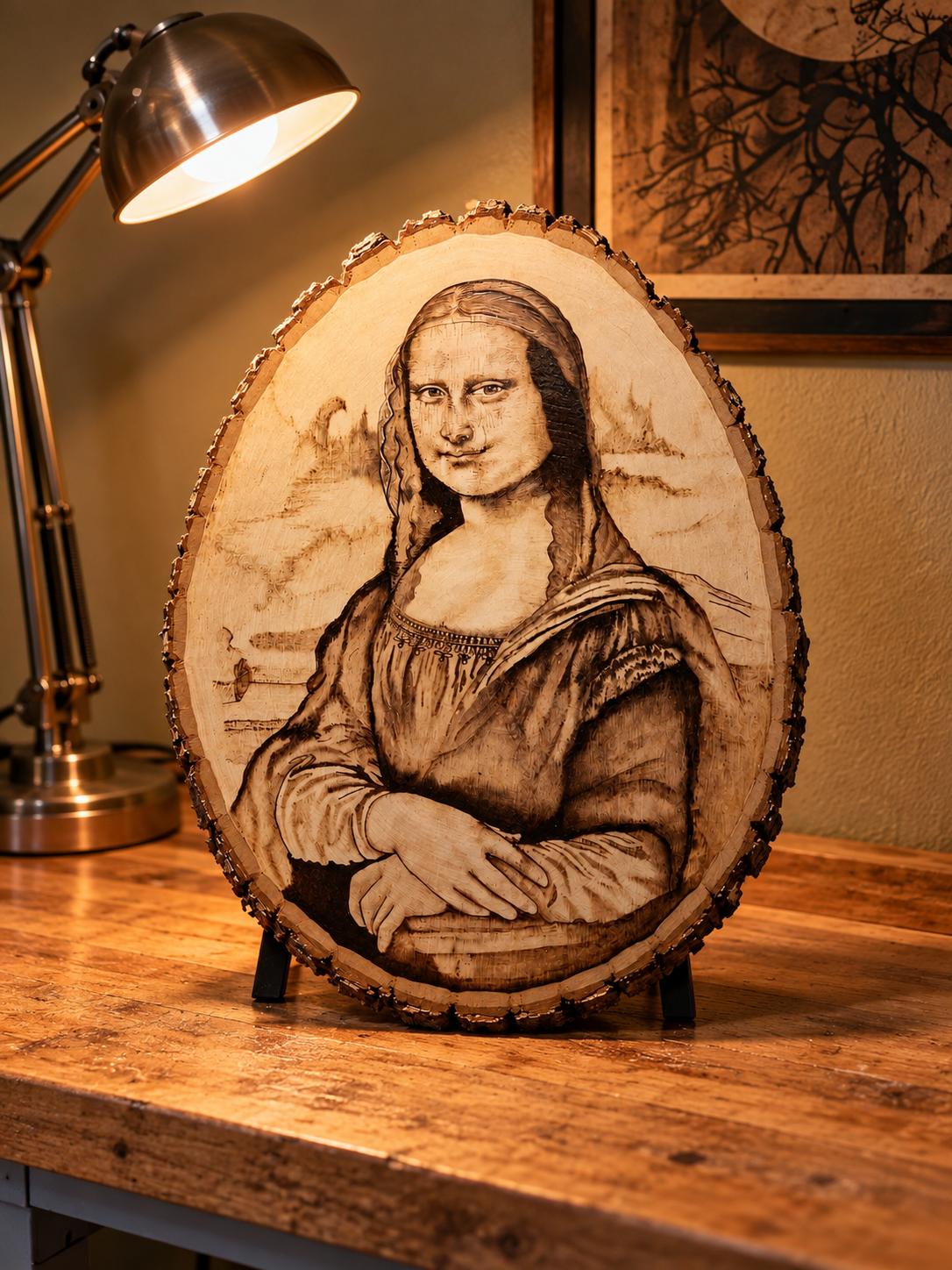
The idea sounded straightforward enough: create my own wood-burned interpretation of one of the most recognizable paintings in the world, Leonardo da Vinci’s Mona Lisa, using a natural oval wood slab with its live edge still intact.
But reproducing a centuries-old painted portrait through pyrography isn’t simply a matter of translating dark areas into burns.
Wood has its own texture. Its own color. Its own grain.
And fire behaves very differently from paint.
That became part of what fascinated me about the project.
Recreating the Mona Lisa With Pyrography
Pyrography—the art of creating images by burning a surface with a heated tool—can produce an extraordinary range of tones and textures.
With portrait work, tiny changes in temperature, pressure, stroke direction, and the amount of time the tool remains against the wood can affect everything from a delicate shadow to a deeply burned line.
For the Mona Lisa, that presented an interesting challenge.
The original painting is famous for its subtle transitions, particularly in the face. Leonardo’s use of sfumato created soft gradations between light and shadow without harsh outlines.
A wood-burning tool doesn’t naturally behave that way.
So rather than attempting to create an exact reproduction in an entirely different medium, I approached the piece as an interpretation.
I wanted her to be unmistakably the Mona Lisa while still allowing the wood—and the process of burning it—to remain visible.
Creating the Aged Texture of the Mona Lisa
One of the details I’ve been most intentional about is the texture of her face.
The original Mona Lisa has the distinctive surface of an old painting. Over centuries, the materials have developed a network of very fine cracks—a phenomenon known as craquelure.
I wanted to echo some of that visual history in the wood.
Rather than creating a perfectly smooth face, I deliberately incorporated fine texture into the burn to suggest the aged surface of the original painting.
It’s a subtle detail.
You might not consciously notice it immediately.
But once you see it, you can’t quite unsee it.
And that’s one of my favorite things about creating art: sometimes the smallest decisions are the ones that give a piece its character.
Working With the Natural Character of Wood
One reason I love pyrography is that the surface is never truly blank.
Before I make the first mark, the wood has already contributed something to the finished artwork.
There are variations in grain, natural imperfections, changes in tone, and—in this case—the irregular organic shape of the live edge.
That means I’m not simply placing an image on a surface.
I’m working with the surface.
The Mona Lisa has been reproduced in almost every imaginable medium, but creating her through burned marks on natural wood changes her character. The warmth of the wood and the permanence of the burned lines give the portrait a completely different presence from paint on canvas—or, in Leonardo’s case, oil paint on a poplar panel.
And I like that.
I wasn’t trying to make another Mona Lisa.
I was trying to discover what my Mona Lisa would look like in fire and wood.
An Unfinished Piece—and Part of the Creative Process
Like many ambitious creative projects, this one didn’t move neatly from beginning to completion.
At one point, I put the piece into storage before it was finished.
But unfinished doesn’t necessarily mean abandoned.
Sometimes an artist needs distance from a piece. You work on something intensely, reach a point where you’re no longer quite seeing it clearly, and move on to something else for a while.
Then one day, you look at it again with different eyes.
The Mona Lisa has remained one of those pieces I know I’ll return to.
And when I do, I’ll be approaching her with everything I’ve learned since I first picked up the burner and began.
Watch My Mona Lisa Pyrography Take Shape
I documented part of the burning process on video, so you can watch the portrait begin to emerge from the wood.
The video captures something a finished photograph can’t: the slow accumulation of individual marks, shadows, textures, and details that eventually begin to look like a face.
I paired the process with “Laid Back Guitars” by Kevin MacLeod, whose warm, unhurried rhythm seemed particularly well suited to watching the piece develop.
▶️ Watch: Burning My Version of the Mona Lisa — Part 1
WATCH THE MONA LISA PYROGRAPHY VIDEO
The Beauty of Making Something Slowly
One of the things I appreciate most about pyrography is that it doesn’t lend itself particularly well to rushing.
Portraits especially require patience.
A little more heat here. A softer layer there. Another pass to deepen a shadow. A tiny line that may barely be visible by itself but contributes to the whole.
Eventually, hundreds or thousands of individual decisions become a finished image.
Perhaps that’s especially appropriate for the Mona Lisa.
The original has survived for centuries, gathering history—and mystery—along the way.
My wood-burned version has taken a rather less direct journey through time. 😂
But she’s still here.
Still unfinished.
Still waiting.
And absolutely still worth finishing. 🔥