Chapter 10
Sunday Best
I was still turning Pruett's rehearsed alibi over in my head when I reached the corner across from the church, Sunday bells already working through their ten-minute warning to the rest of town. He'd volunteered his whereabouts before either of us had asked for them, laid out in careful order like a man reciting something under pressure, and by the time Finneas closed his notebook I genuinely couldn't tell whether we'd watched a guilty man perform or an innocent one panic. Four pages of notes, and Finneas had looked more tired at the end of it than satisfied. I didn't feel much better. The whole conversation was still sitting in my chest hours later, and I hadn't found a version of it yet that actually made sense.
Finneas was crossing Main Street from the opposite corner when I looked up, hands shoved in his coat pockets, wearing an honest-to-goodness tie that looked like it had been fighting him since the moment he put it on.
“You're wearing a tie,” I said once he was close enough.
“I'm aware.”
“For church.”
“I'm observing, not converting. Seemed like the polite middle ground.” He fell into step beside me.
“You look nervous,” I said, mostly to fill the last block before the church.
“I look like a man who hasn't entered a church in a very long time. There's a difference, though I understand the confusion.” He glanced sideways at me. “You, on the other hand, look,” he slowly assessed me from head-to-toe, entirely unrepentant, “beautiful”. And we crossed the last stretch of green in a silence that felt, for once, more companionable than tense.
Muninn was in the oak when we passed beneath it, a dark shape against branches gone mostly bare, and he didn't so much as ruffle a feather as we walked under him. Finneas glanced up at the bird and then at me.
“Does he approve of church?”
“He doesn't approve of anything. He tolerates.”
“High praise, coming from him.”
The church sat at the far end of Main Street, where the cobblestones gave way to a wide swath of green lawn, white clapboard and a black steeple visible for at least a mile in every direction — the postcard version of a New England church. Cars filled the small gravel parking lot and lined both sides of the street.
The front steps had turned into a small social event: calf-length coats, gloved handshakes, someone's golden retriever tied patiently to the iron railing, entirely unbothered by the pageant going on around him.
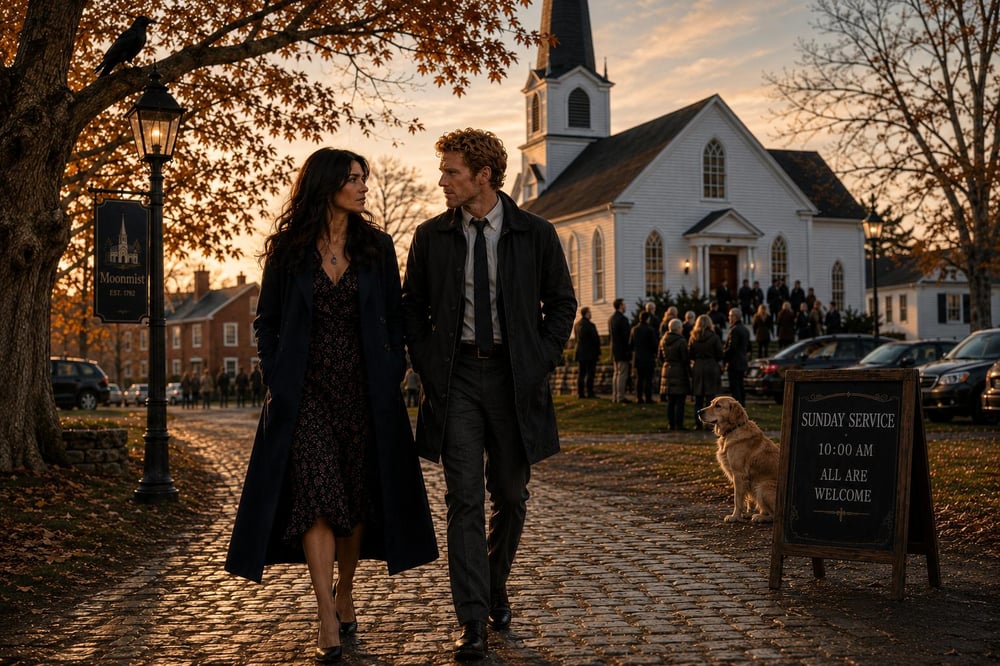
I spotted Dottie near the bottom of the steps wearing a blue wool coat I'd never seen her wear at the diner. She was deep in conversation with a blonde woman I didn't recognize, and she lifted her hand in greeting as we passed. Moving through the crowd and into the vestibule, I saw Mrs. Abernathy already seated inside, visible through the open doors, working her way through the church bulletin. It struck me, climbing those steps, how much of the town I already recognized after such a short time — how quickly a collection of strangers had started resolving into people with names and habits and Sunday coats.
Somewhere behind us, a group of teenagers filed past in matching discomfort, ties and collars clearly imposed rather than chosen, and one of them — the boy who'd bought lavender for his mother's birthday, I realized — caught sight of me and went slightly pale before quickly looking away. Apparently, my joke about the raven had more impact than I'd intended.
I saw Reverend Creed before Finneas pointed him out, standing at the front of the chapel, working the crowd with unhurried confidence. Here was a man who'd clearly done this exact thing every Sunday for thirty years and never tired of it. He remembered names, which parishioner's grandchildren had just started kindergarten, whose knee surgery needed asking after. He touched an elbow here, clasped a hand there, and made every single person on those steps feel, briefly, like the only one in Moonmist worth his attention that morning. It was an impressive skill. It was also, I couldn't help noticing, the same skill Dottie used to run a diner and Tilda used to run a café — every person of note in this town seemed to embody some version of it. The difference was that Creed's brand of charisma came with a collection plate and decades of unquestioned authority standing behind it.
“Briar Calloway,” he said, before either of us had gotten a word out, and I understood in that instant that he'd known exactly who I was since long before I crossed the town line. “Sylvie's granddaughter. We've all been hoping you'd find your way to us.” He extended a powerful hand, warm and dry and certain, a heavy gold ring with a large red stone catching the light on his third finger.
I grasped it without thinking — which, I realize afterward, standing in a church that smelled like candle wax and old hymnals, was precisely the automatic, instinctual gesture that got people in this town in trouble.
The warmth hit first — sudden and immediate, with the same traveling heat the brooch gave off, up through my palm and settling behind my ribs before I could brace for it. Then came the rest, layered fast on top of itself: a searing, old pulse of guilt, carefully managed, worn smooth from years of being managed and ignored. Underneath that, was the fear — not of being caught, exactly, but of being fully seen by someone whose judgment carried the same weight his own claimed to. And then, for less than a second: there was the flash of a much larger sanctuary than this one, glass and steel and stadium lighting, a young man at a pulpit with Creed's same easy persona, and a folded check changing hands between two people who both looked like they wanted the moment over before it started. Then, almost a background noise — an old woman's voice, tight and controlled, saying something I couldn't quite catch, and then nothing, just silence where the sound had been.
I quickly withdrew my hand, trying not to hyperventilate.
“Cold morning out there,” he said, mistaking my hesitation for a shiver. “You have your grandmother's eyes, you know. I always thought Sylvie saw a great deal more than she ever let on.” He said it lightly, almost fondly, which was somehow the most unsettling part of the whole exchange.
“This is Finneas,” I managed. “He's a reporter. From Portland.”
“Oh, I know exactly who Mr. Reed is.” The reverend's smile didn't move an inch. “Detective Wexford speaks very highly of your thoroughness.”
“I do my best,” Finneas said, matching him smile for smile, and I had the distinct sense of two men shaking hands over a chessboard neither of them had admitted to setting up.
Creed turned back to the next family climbing the steps, already reaching for a new name, and Finneas and I moved through the chapel, the smell of candle wax and old wood polish and someone's overloved perfume imbuing the space. We found seats near the back at Finneas's quiet suggestion — close enough to watch, far enough not to be noticed.
“Where did you go, just then,” he asked quietly, once we'd settled. “With Creed.”
“I'll tell you after,” I said, and he nodded like that was a perfectly reasonable answer.
The organ started playing, and the congregation rose around us in a single practiced motion, and I stood with them, trying to look like a woman thinking about hymns instead of a folded check and a stranger's hands. The impression hadn't come with any solid details I could take to Detective Wexford with a straight face. But it had come with a feeling I recognized from the Three of Swords, faint but unmistakable, like hearing the same chord struck twice in two different rooms. Whatever Granny Orin had seen in that reading room, some version of it had just passed through me on a church step, wearing a gold ring and a comment about the cold.
Creed's sermon that morning was about grace extended to those who least expect to receive it, delivered with the same unhurried warmth he'd used on the steps. It took every ounce of self-control I owned not to turn and look at Finneas when Creed said, without a trace of irony, that the Lord's mercy covered the sins of every believer, especially those who felt unworthy of His grace.
Beside me, Finneas went very still.
He'd heard it too, then. Whatever performance Creed was putting on for three hundred people in their Sunday best, at least two of us in the room were listening for something underneath it, and neither of us, I suspected, was going to say so until we were somewhere far away from the church, with a door that closed.
Near the end of the service, while the congregation bent their heads for a closing benediction, I looked up — I couldn't have said why, except that some part of me needed to check — and found Creed already looking back at me from his seat behind the pulpit, his expression as warm and untroubled as it had been on the front steps. He held my gaze until the prayer was finished, not a moment longer, and then rose to his feet, greeting folks with what appeared to be a genuine smile.
It wasn't a threat. It wasn't even close to one. But I didn't miss the implication, sitting in that pew with my hands folded like everyone else's, that the man had noticed me noticing him, and that he wanted me to know it.